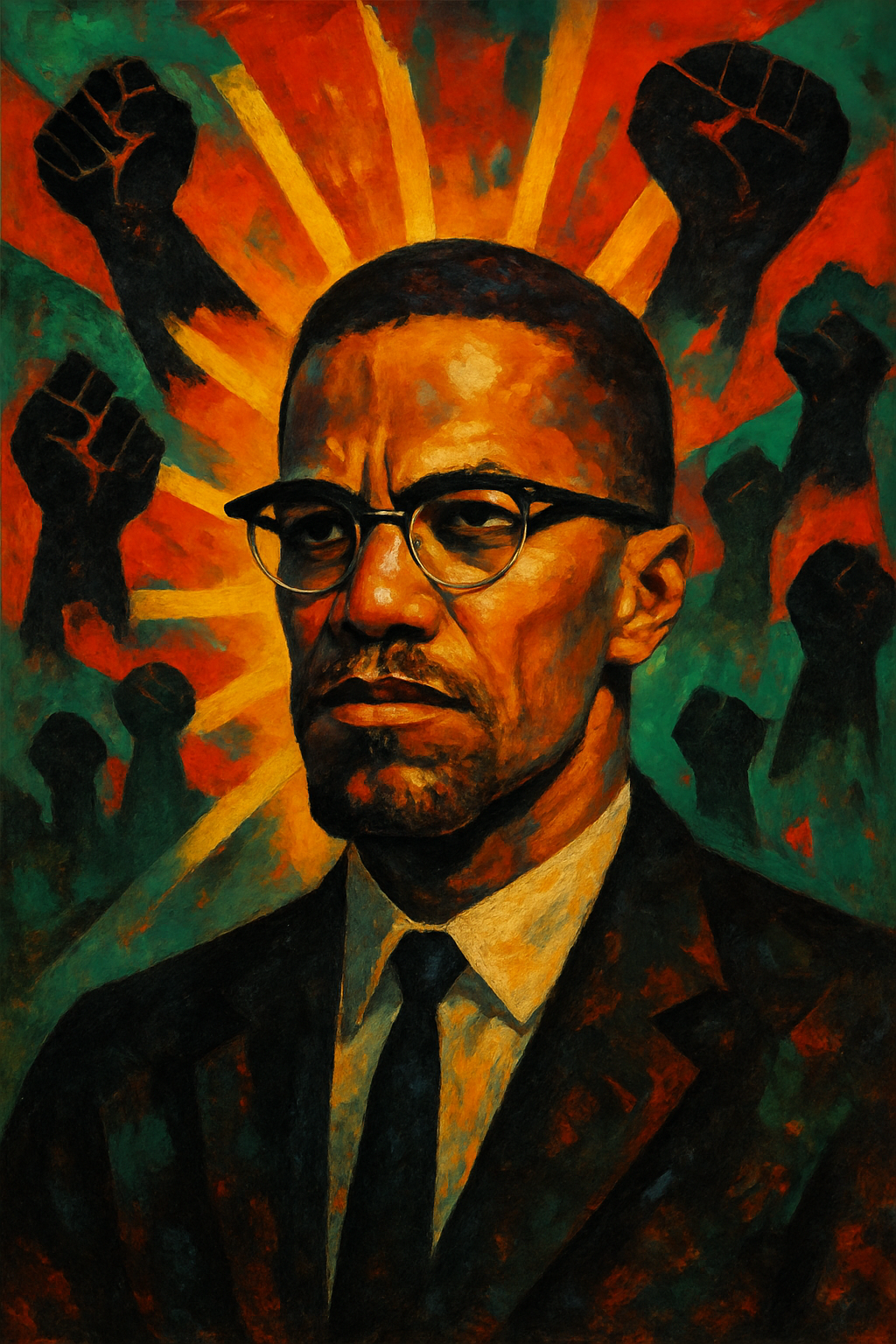
This month, we marked what would have been the 100th birthday of El-Hajj Malik El-Shabazz—known to the world as Malcolm X. A century after his birth, his words still cut with precision, his image still stirs the spirit of rebellion, and his life still stands as a reminder that dignity, once claimed, can never be given back.
Malcolm was not the safe, sanitized civil rights icon that history textbooks often prefer. He did not trade truth for comfort. He didn’t ask America to love him—he demanded it reckon with its crimes. And for that, he was feared, hated, surveilled, and ultimately assassinated.
Yet here we are. A hundred years later, his voice is louder than ever.
From Ferguson to Gaza, from prison yards to campus walkouts, the influence of Malcolm X is alive in every movement that refuses to be polite about injustice. His commitment to Black self-determination, international solidarity, and truth-telling at all costs continues to shape a generation raised on hashtags, abolitionist thought, and the global demand for liberation.
We remember Malcolm as a man of transformation—a figure who was never afraid to grow, to rethink, to question even his own beliefs. That capacity for evolution is part of what makes his legacy so dangerous to systems that rely on rigidity and obedience. He was a threat because he thought for himself. And he taught others to do the same.
For me, his legacy isn’t just a matter of history—it’s personal. I’ve had the immense honor of working alongside Ilyasah Shabazz, Malcolm X’s daughter, who wrote the foreword to Reimagining the Revolution. Watching her carry her father’s legacy forward—with the same fearlessness, clarity, and moral conviction—is one of the most powerful experiences of my life. She is a living testament to his enduring impact: unapologetic, unafraid, and unwavering in her pursuit of justice.
But legacy is more than memory. It’s a living thing. It’s what we do with the truths he left behind.
So as the commemorations fade, we ask:
Will we echo Malcolm’s clarity when we see injustice?
Will we carry forward his insistence that our struggles are global, not isolated?
Will we, like him, refuse to be tokenized, diluted, or tamed?
Malcolm X didn’t live to see his 40th birthday. But 100 years after he was born, the movement he inspired is still unfolding.
Let’s not just honor him. Let’s be him—bold, evolving, and unafraid to name the enemy.