The chaos of the present can feel so consuming that it blots out the past, as if there’s no precedent to measure it against. The Trump Administration is counting on that amnesia as it wages its latest battle for America.
Khaled Abdelghany, who served as a member of the D.C. National Guard’s Military Police until last year, knows that battle well—he stood on its front lines in 2020. On June 1 of that year, peaceful demonstrators filled Lafayette Square to protest the killing of George Floyd. The majority-Black D.C. Guard was already in turmoil. “Putting on the uniform doesn’t make us blind,” Abdelghany told me. Service men and women were still processing the now-viral footage of Floyd being suffocated. Instead of space to reckon with it, they were handed hockey pads and batons and ordered to stand as a show of force.
The guards were so strikingly disturbed that a demonstrator captured it on film, zooming in on Abdelghany as he mouthed “I’m Black and I’m Proud” in unison with protestors, a quiet act of solidarity that quickly ricocheted across the internet. Hours later, he stood in formation with a shield, watching the president turn the day’s chaos into a political backdrop.
Before the 7 p.m. curfew, law enforcement—led by U.S. Park Police with the support of the Secret Service, Federal Protective Service, and other federal units—was alerted that the president wanted to make an unscheduled appearance at St. John’s. Abcelghany’s unit was ordered to participate in a violent sweep of denizens, pushing them out using batons, shields, smoke, and chemical irritants. Minutes later, Trump strode across the newly cleared.
“It made me think, ‘you really don’t need us—you’re just making a power move,’” Abdelghany said. “And a power move against our own people? That’s just crazy to me.”

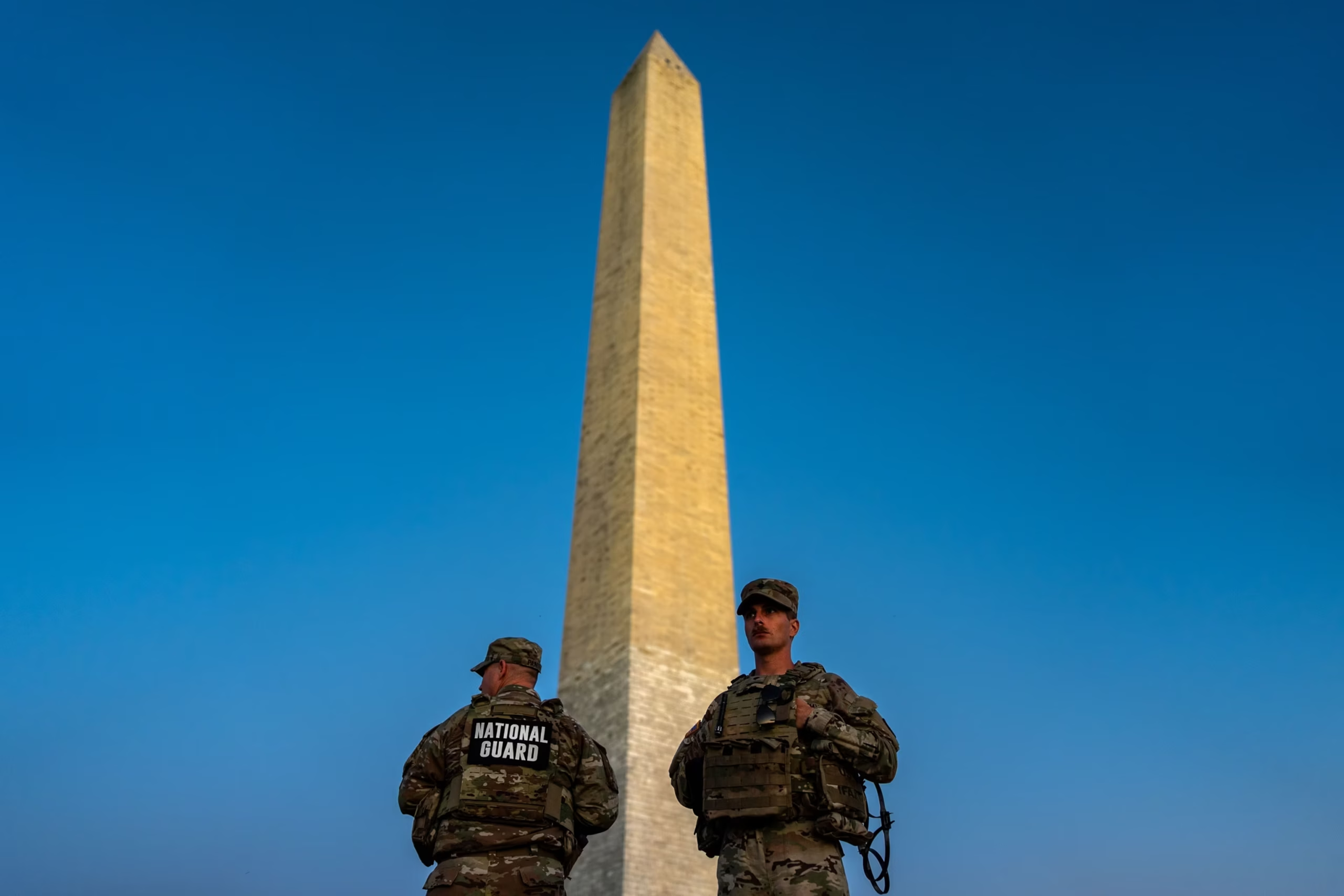
In Washington, D.C., the National Guard isn’t under the authority of a governor—it answers directly to the president through the Secretary of the Army. That makes it unlike any other Guard unit in the country. When ordered into the streets, Guardsmen are bound by an oath to “support and defend the Constitution of the United States”—an oath that protects, among other rights, the freedom to protest. But in moments like June 1, 2020, that oath becomes both conflicted and ironic: the same service members sworn to uphold the First Amendment were deployed to silence it, standing as a human barrier between a president and his people, not to defend public safety, but to secure political optics.
Now, Trump has again ordered the D.C. Guard into service. The circumstances differ—different justifications, different streets—but Abdelghany’s reaction is the same: skepticism. “Don’t just put us out there as a wall or a threat. That’s not protecting anyone. That’s sending a message.”
The message, he believes, is less about public safety than about political theater.
“Good leaders will ask you to question things that aren’t right,” he told me. “They’ll make sure you have a solid mission and the tools to carry it out. If you can’t give us that, then why are we there?”
The 2021 Interior Department Inspector General report on Lafayette Square concluded the Park Police cleared the area to install antiscale fencing, not to enable Trump’s photo-op. For Abdelghany, and for many watching, the intent hardly mattered. The effect was the same—power and intimidation on one side of the line, the public on the other.
And when the Guard is placed in that position—physically present for a mission they don’t control, mentally questioning its legitimacy—the consequences go beyond that day’s headlines. It erodes trust, both in the institution and in the idea that those in uniform are there first and foremost to protect the people.
The Guard can play an essential role in real emergencies: natural disasters, civil unrest that turns violent, imminent threats to life and property. But when their deployment becomes part of a political performance, it undermines that role. It turns citizen-soldiers—many of whom live in the very communities they’re sent to “secure”—into symbols of force rather than agents of protection.
Looking at the current deployment through the lens of 2020, Abdelghany’s question becomes ours: Are these troops here to keep people safe, or to send a message? Because if it’s the latter, the message isn’t one of safety or democracy. It’s a question of what our democracy has become.