“The only thing we ever did wrong was to stay in America too long.”
James Baldwin, 1967
Today marks the start of one of the worst waves of racial unrest in U.S. history. From May 1 to October 1 of 1967, more than 40 major riots and over 100 other uprisings exploded across American cities. It wasn’t random. It wasn’t senseless. It was rebellion.
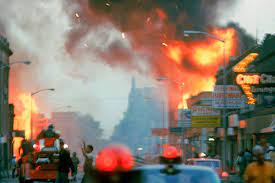
In Newark and Detroit—cities still synonymous with Black resistance—residents rose up against police violence, economic apartheid, housing discrimination, and political abandonment. They were met with even more police violence and discrimination. Tanks rolled through American streets. Snipers fired from rooftops. The National Guard was deployed in force. A fully militarized police force took aim at the very people they were charged with protecting and serving. And when the smoke cleared, dozens were dead, thousands arrested, and entire neighborhoods reduced to rubble.
But this was not merely chaos—it was protest in its rawest form. Decades of broken promises, joblessness, segregated schools, and police brutality had created a powder keg. It was lit by a new generation that refused to accept the lie that the Civil Rights Act had solved racism.
President Lyndon B. Johnson, rather than addressing the root causes, formed the Kerner Commission to investigate. Its 1968 report famously concluded: “Our nation is moving toward two societies, one Black, one white—separate and unequal.”
It wasn’t a warning. It was a statement of fact.
Why It Still Matters
The summer of 1967 was a turning point. It revealed not just the deep racial fault lines in American life, but the limits of reform without transformation. It forced the nation to reckon with the reality that civil rights legislation alone could not dismantle systemic racism.
Today, we’re still fighting many of the same battles—against over-policing, housing segregation, underfunded schools, and economic disenfranchisement. The conditions that sparked rebellion in 1967 have evolved, but they haven’t disappeared.
As we remember this season of uprising, we honor not only the pain but the courage of those who refused to be silent. We also recommit to telling the full truth about American history: not as a straight line of progress, but as a series of ruptures, revolts, and reckonings.